Happy Monday! Two weeks in a row I’m here where I’m supposed to be, when I’m supposed to be. I hope you’ve had a great week.
Last week I told you about Birdie Books in Westerville, Ohio and one of the books I mentioned was 52 Diverse Titles Every Book Lover Should Read. I’m often curious about those ‘should read’ lists and check them to see how well I measure up. Not very well usually. I appreciate the suggestions, but I also don’t feel guilty if I completely disregard many of them. But as I’ve mentioned publicly and challenged myself personally, I want to broaden my reading which in turn will broaden my horizons. When I saw this book, I thought it might be the roadmap I could use to take that trip.
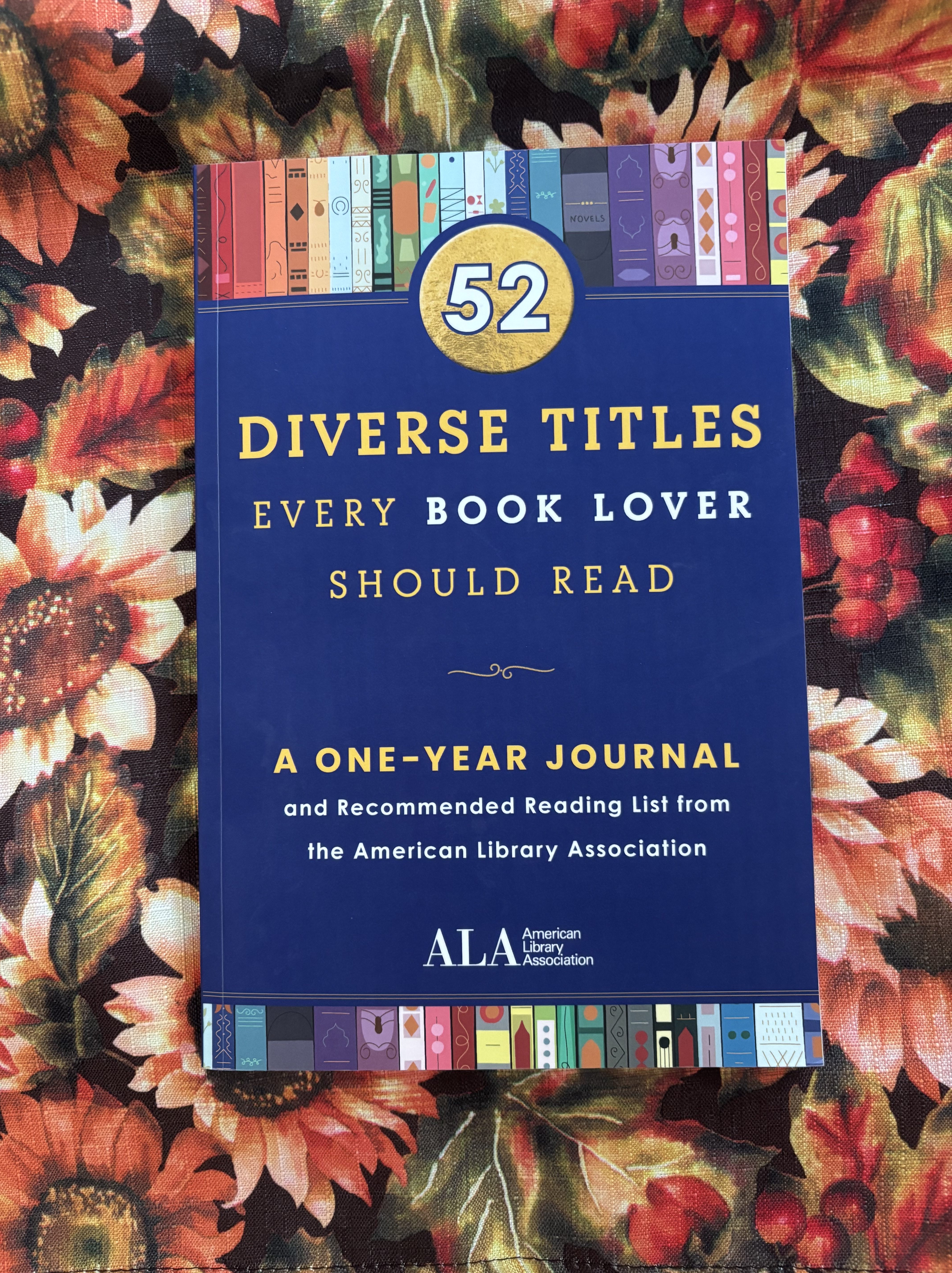
The book is primarily a journal based on the 52 titles it recommends, each by a different author. I’m familiar with a handful of them–Edwidge Danticat, Louise Erdich, James McBride, Colson Whitehead, and Jacqueline Woodson. I’ve read other works by some of these authors, but not the books recommended here. Among the books are novels, memoirs, and collections of short stories, so a nice variety. These are five of the titles.
In Americanah by Chimamanda Ngozi Adichie the author explores racial strictures within the Black community through the eyes of Ifemelu, a Nigerian immigrant. Being Black in America is not the same as being a Non-American Black.
Homeland Elegies by Ayad Akhtar is also an immigrant story, or rather linked short stories, of a young Pakistani before and after 9/11 and his place as a Muslim in America.
The Firebrand and the First Lady: Portrait of Friendship: Pauli Murray, Eleanor Roosevelt, and the Struggle for Social Justice by Patricia Bell-Scott is based on the true story of the long-time correspondences–almost a quarter of a century–between these two women. Coming from very different backgrounds–one of privilege, the other the granddaughter of a slave–they still found things in common and together fought for social justice.
Twenty-five years ago, Hurricane Katrina obliterated parts of New Orleans, almost 100 bodies have never been recovered. In The Yellow House, Sarah M. Broom reflects on the disconnect and wanderings of all those displaced by the floods, but also how her family bond was stronger than the family home that was destroyed.
American War by Omar El Akkad is set in 2074 during a second American civil war. The effects of global warming have come true with the Midwest, specifically Columbus, Ohio, being one of the centers for refugees escaping the coastal areas. (That alone piqued my curiosity!)
Other titles include: The Water Dancer by Ta-Nehisi Coates, Everything Inside by Edwidge Danticat, The Night Watchman by Louise Erdrich, Crooked Hallelujah by Kelli Jo Ford, Transcendent Kingdom by Yaa Gyasi, The Beauty in Breaking by Michele Harper, Echo on the Bay by Masatsugu Ono, Looking for Lorraine: The Radiant and Radical Life of Lorraine Hansberry by Imani Perry, Just Mercy by Bryan Stevenson, and The Last Great Road Bum by Hector Tobar.
Have you read any of these? If so, what did you think?
For each title there’s a journaling question based on issues raised in the book, and three pages for responding. Here’s a sampling of the questions:
Describe the communities you’re part of and why they’re important to you?
What soundscapes enrich your life?
How have your beliefs changed over time?
Write about a time when you had to play a role that didn’t fit you.
My guess is I can answer those journaling questions now, but after reading the book assigned to each specific question, I may answer it differently. Even though the journal is set up to read one book a week, I doubt if I’ll tackle that timeframe! But I’ll review some of the books during future Book Review Mondays!
So, what does this have to do with eating pizza? I think–hope–that by reading these books about others, I’ll find points of connection I may not have known existed. At the very least, I hope they fortify my compassion and empathy for others. And that’s where the pizza comes in.
My friend Laura’s daughter, Katie Shull-McManus, remarked to her in the last week or so, “People focus too much on differences rather than on what we have in common with others. We should strive to find things we have in common. If the only thing we can find is that we both like pizza, then we should sit down and enjoy pizza together.” KT credits the idea to another woman, Miss Paulette. No matter who coined the idea, I think it’s a great one.
I read an article earlier today stating that while ‘… 80% of Americans believe empathy remains a moral value and the foundation of a healthy society,’, over 50% in each of two specific groups believe empathy is dangerous.
I’m in the camp that believes empathy has value and the best way to grow in that is to listen to other people’s stories. So, anyone up for pizza?
I hope you have a wonderful week! Enjoy the little goblins and superheroes arriving at your door this weekend. And remember, if one of them extends a blue Halloween bucket, that means the child is autistic, non-verbal, or otherwise faces challenges with social communication. I’ll be back on Monday. I hope you’ll join me.