
The month of November is National Native American Heritage Month, celebrating and recognizing the history, culture, and achievements of Indigenous Peoples. I wish we’d had this month when I was growing up.
I knew the tribal names of Wyandot, Mohican, Seneca and Erie in our general area of Ohio, but nothing specific about individuals or tribal histories. I was familiar with Cherokee, Apache, Iroquois, Hopi and others, (who wasn’t since we watched Bonanza and The Rifleman), but other than when Christopher Columbus ‘discovered’ America, I remember few history lessons where Native Americans were the focus. Maybe the boys in my class read more tales about them on their own, but I was reading Nancy Drew.
I still have the American History course I used with my son when I homeschooled and the story of our Native Peoples is interwoven throughout our country’s story. But I still question how completely that history is written.
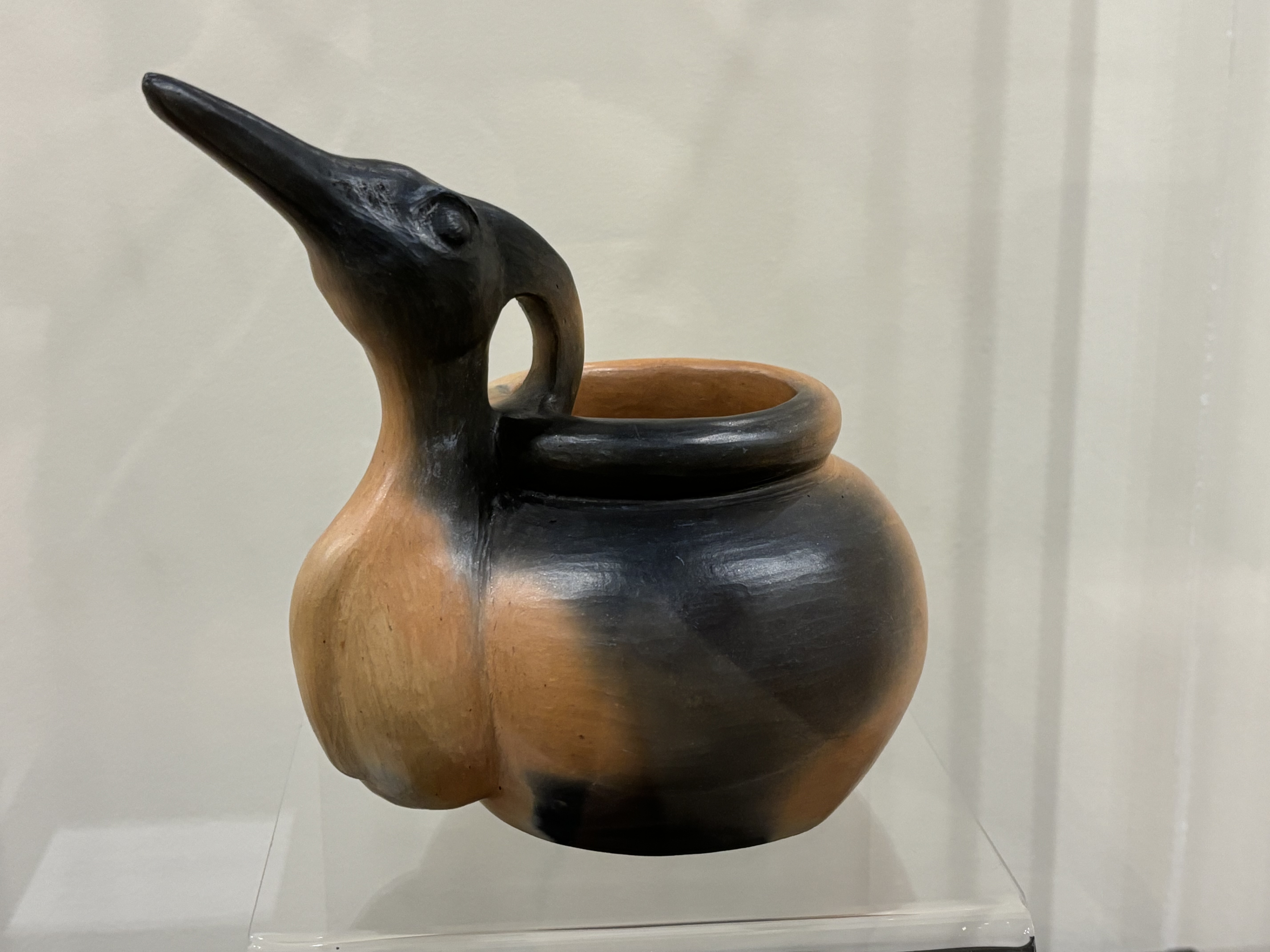
In my area of the Carolinas, the Catawba Nation has a reservation on land much smaller than its original area. This is a piece of Catawba pottery, famous for its colors and the process in creating it. The story of the Catawba is the same as the histories of other Native peoples: occupied the land for thousands of years before Europeans arrived, had a form of government, had their own spoken language, stories, and myths, were reduced in number due to disease and enslavement, and forced off their land through shady land deals and marches to other territories. In 1847 the South Carolina governor declared ‘They are, in effect, dissolved.’
Thankfully, Lancaster has the Native American Study Center, part of the University of South Carolina, to “… advance the history and cultures of South Carolina’s Native communities … bringing together art, archaeology, folklore, history, and language.” Their history wasn’t completely lost, and the Catawba never were.
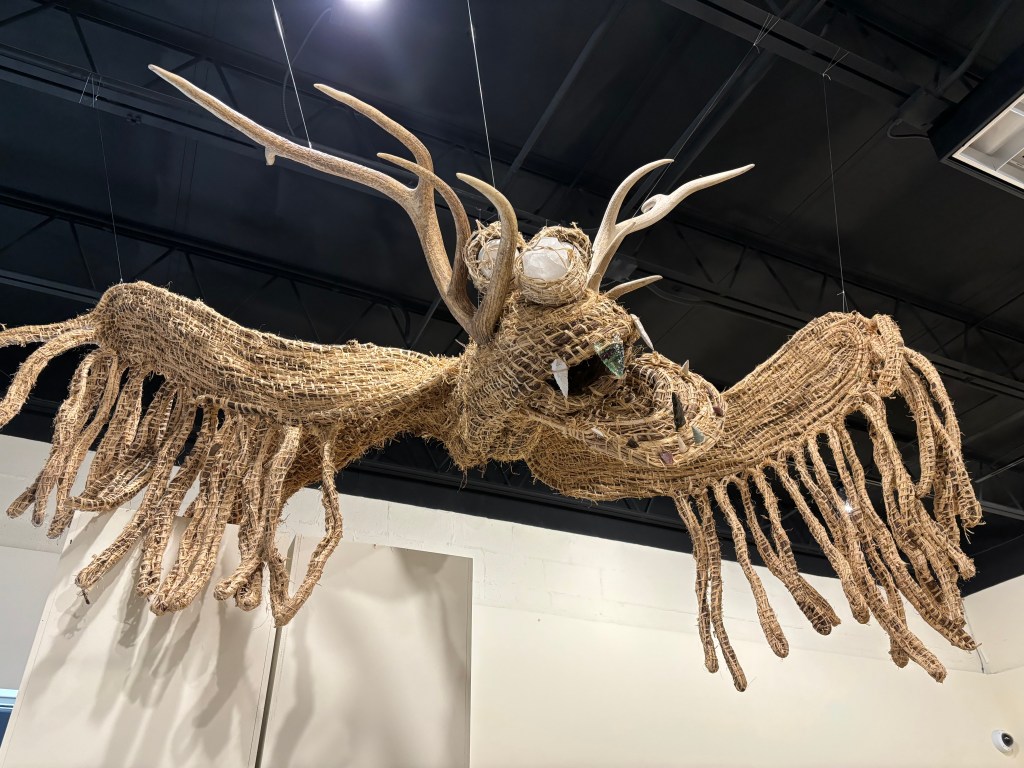
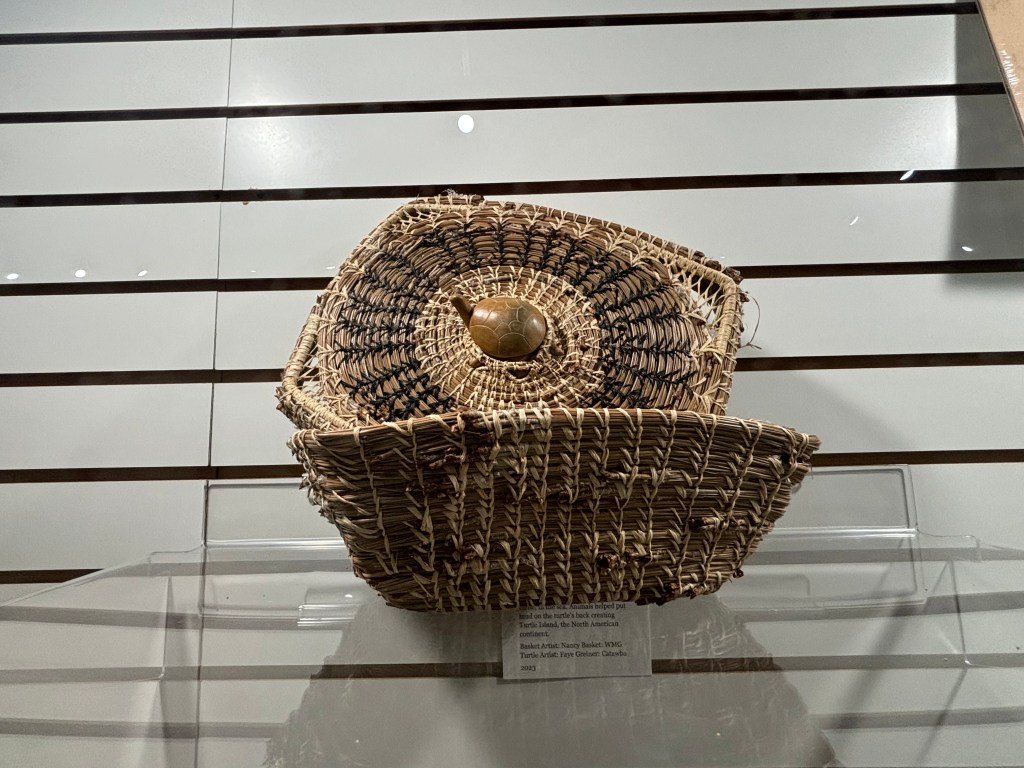

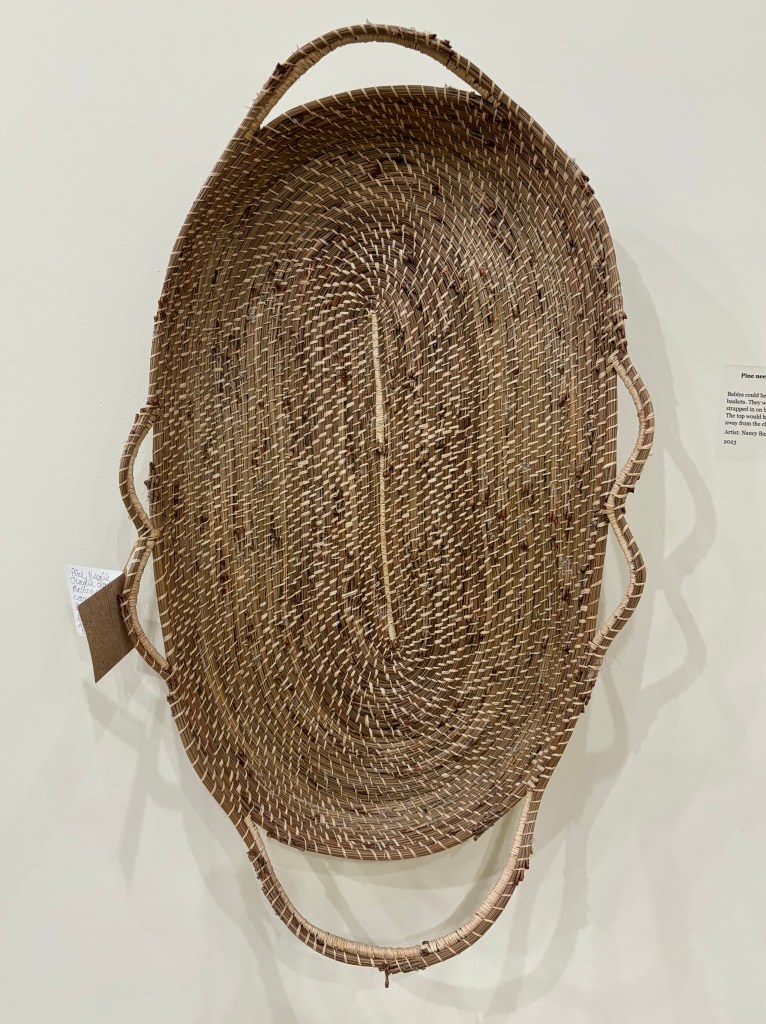
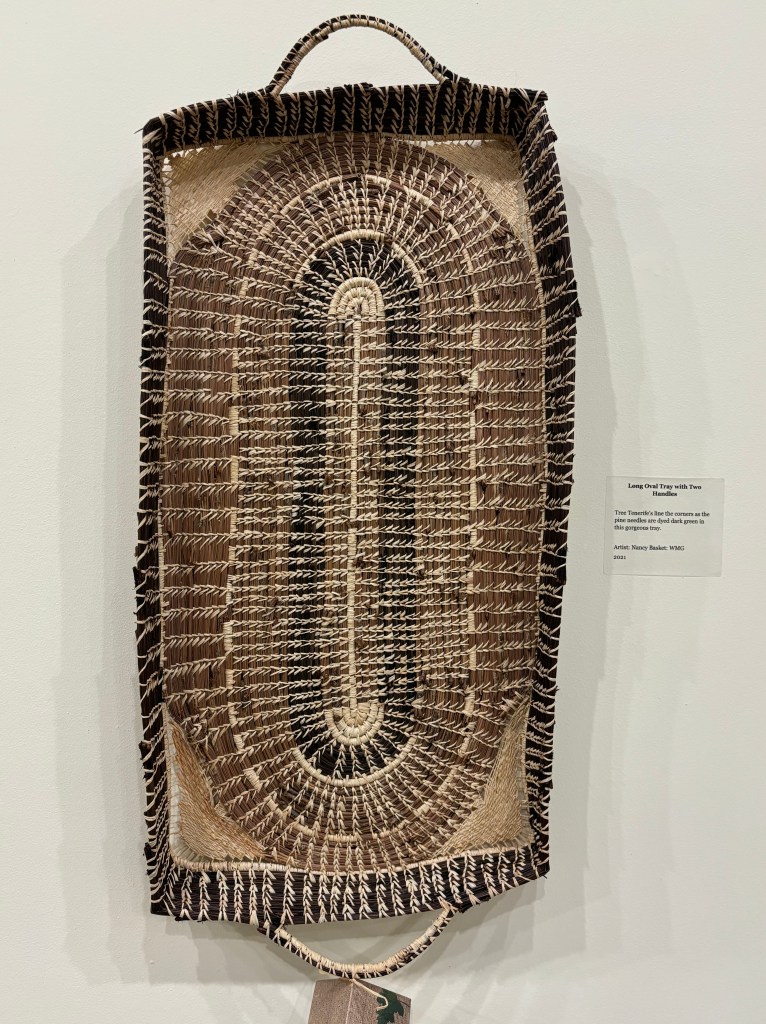
This artwork is part of Nancy Basket’s exhibit, Backyard Vines. A member of the Catawba Nation, Nancy wove the pieces from backyard vines of kudzu, honeysuckle and others, and pine needles. At the moment there’s still an ever-abundant supply of materials for the art. Included in the exhibit are larger pieces such as two floor lamps and the Thunderbird, protector against evil spirits.


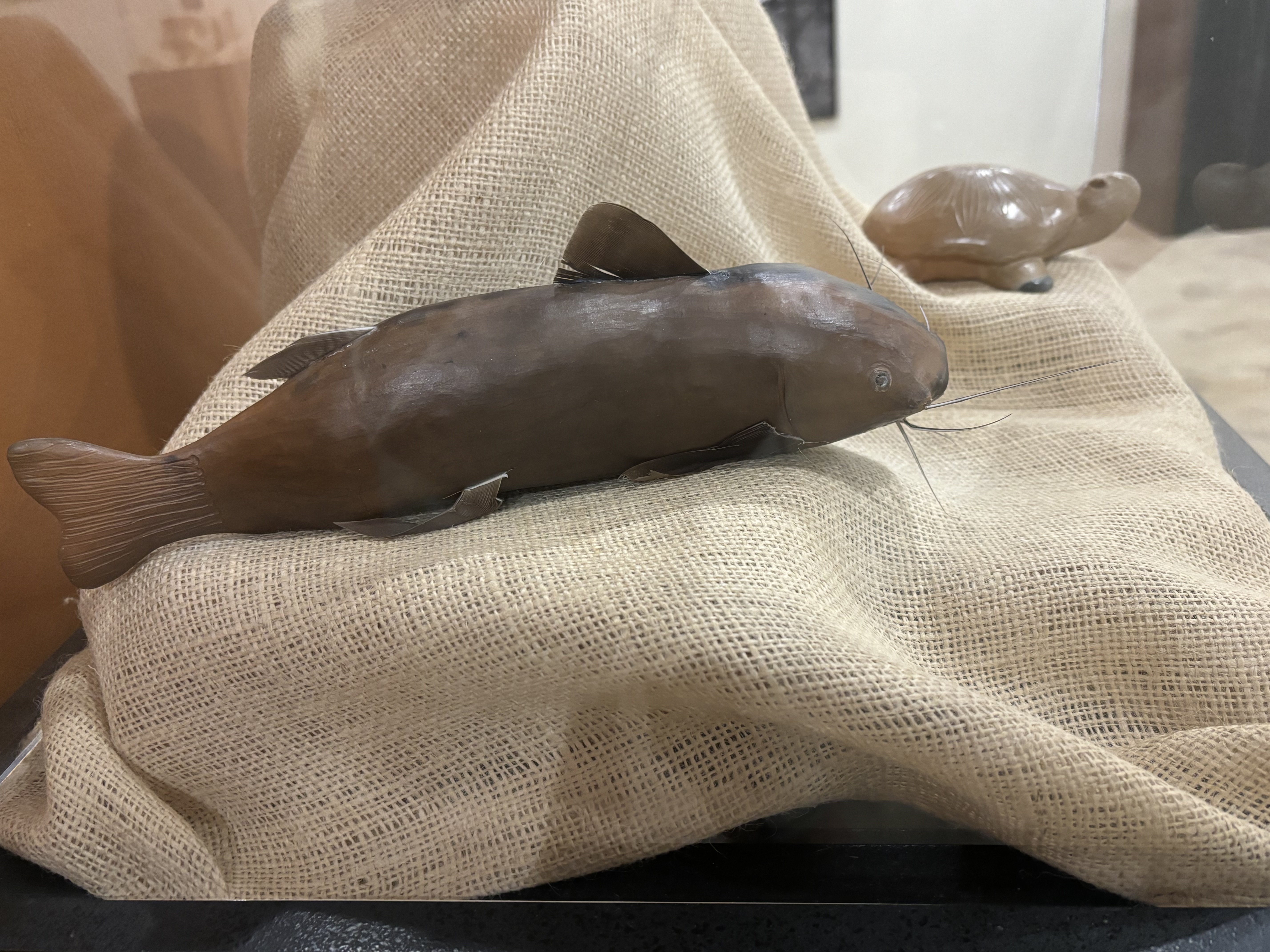
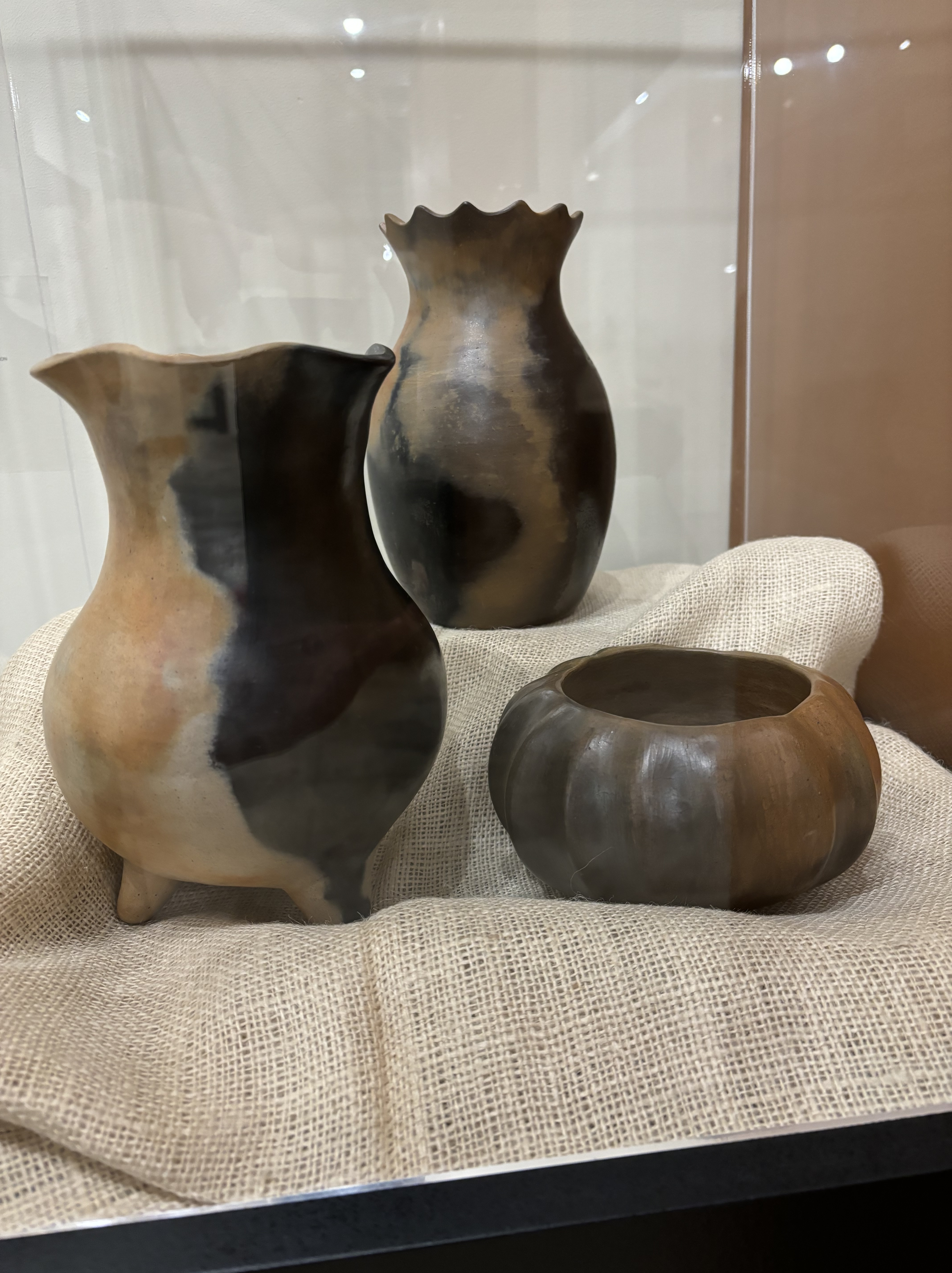
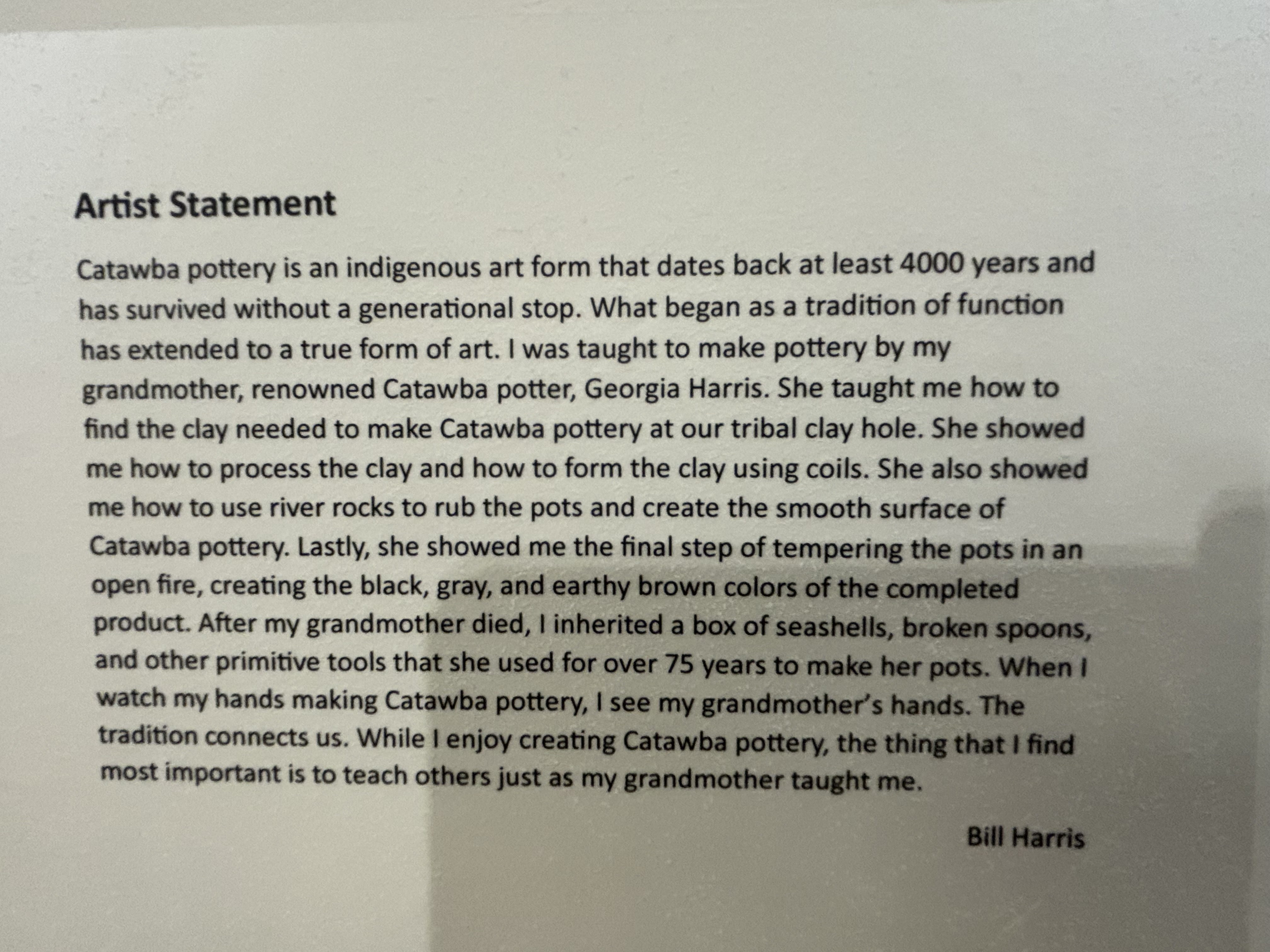
The Catawba call themselves Iswa, People of the River, and their pottery, especially, makes that connection. The source of Catawba pottery, a specific type of river clay found only in this region, is finite, and so the supply is protected. The process of gathering the clay is more than simply going to the riverbank with a shovel and a bucket, there’s a traditional way of removing and refining the clay before it can be used. It’s labor intensive and passed down from one generation to the next. It’s a sacred act. The pottery in the above photos was created by either Bill Harris, his grandmother Georgia, or his students.
The pots and other vessels–some are useful, like cooking pots, and others are decorative–are coil built, not shaped on a wheel; they’re hardened in a coal fire, not a kiln. The beautiful colors are a result of the color of the clay and the firing, and the glaze-like appearance comes from scraping it with a river stone at a certain step in the process. I’m making this sound much simpler, easier, and quicker than it actually is!
Animals are often depicted on the pottery–turtles, birds, and snakes. The black snake is to scare off any creature that fancies eating the contents of the cooking pots.
According to an article by Tom Poland, a local author, ‘… the Catawba pottery tradition has been passed down over 6,000 years, making it the oldest continuously practiced art form east of the Mississippi.’
Even when declared ‘dissolved’ in 1847, the Catawba maintained their connection to the river, their tradition of making pottery.
I wrote earlier about family and the challenge, but the importance, of keeping our family stories and connections. I try to wrap my head around the idea of ‘dissolving’ a whole culture, a nation, a people, and the complete loss of its language, history, art, traditions, and heritage. It’s not only difficult, it’s scary because it continues to happen. I find these months of ‘Awareness’ important reminders and opportunities to fill in my own educational gaps.
The Native American Study Center is free and open to the public, (took two of the Grands and they loved it). In addition to the gallery exhibits and children’s area, it offers programs, special events, demonstrations, and access to the archaeological lab where you can observe the archiving process first hand. The Archives are also open to the public. In coordination with the University of South Carolina, one can earn a degree focused on Native American Studies. If you’re ever in the area it’s an interesting place to visit.
There’s another week or two left of Native American Heritage Month, enough time to discover a little something about the Indigenous Peoples in your area. On Saturday, the Catawba will hold their Yap Ye Iswa Festival, a day of music, dancing, and food. A rather appropriate event the week before Thanksgiving … when we remember the Pilgrims and the Native Americans. I hope you have a wonderful week and I’ll be back at my window on Monday!
 A Writer's Window