Last week I reviewed the book, Now is Not the Time to Panic by Kevin Wilson, and wrote about art and what happens once a work is out in the wild, the fact the artist has little control over it at that point. This week’s post is about what happens when that art takes on another form—a sort of shape-shifting in the art world. One way this works is through ekphrasis. It does sound kind of sci-fi doesn’t it? But it’s a real word and a real form of poetry.
According to the J Paul Getty Museum, ekphrasis (ek-fra-sees) or ekphrastic poetry has come to be defined as poems written about works of art; however, in ancient Greece the term ekphrasis was applied to the skill of describing a thing in vivid detail.
But I like another source’s definition better. ‘In addition to the description of a work of art, an ekphrastic poem usually includes an exploration of how the speaker is impacted by his or her experience with the work. For example, in John Keats’s ‘Ode on a Grecian Urn’, the ancient vessel piques the curiosity of the speaker who asks: ‘What men or gods are these?’
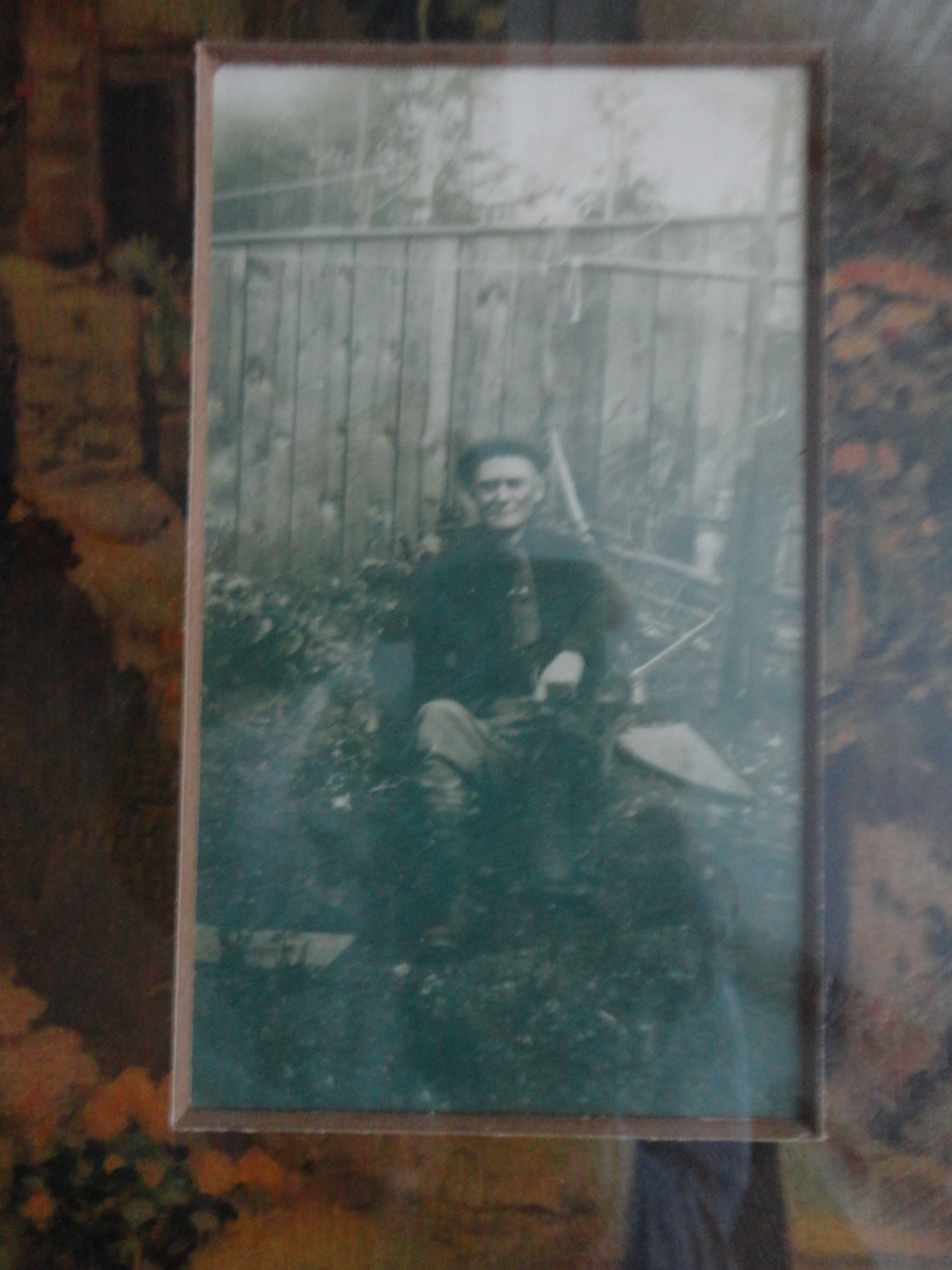
And so meet Al. He’s not a god, but a man. My guess middle-aged. I found him in some long-forgotten junk store and brought him home. See, I collect old photos, black and white and sepia toned, and they are the art that inspire some of my ekphrastic poetry. If there’s an inscription on the back, all the better.
What first caught my attention is Al’s expression. He has a kind, clean-shaven face. I can imagine it’s almost soft to the touch, no stubble. But there’s an intensity in his eyes, not mean, but studying. There’s a hint of a smile, but only a hint. His is not that somewhat blank, stoic expression we often find in old photos.
He’s wearing a cap, like a newsboy cap, a jacket, what looks like a tie, pants, boots. He’s dressed to have his photo taken, and there’s something of an immigrant or Old World look about the style of his clothing.
Then it’s the setting. He sits in what I envision is a wicker chair, beneath a clothesline. Behind him is a well-made wooden privacy fence, but also a rustic rail fence with vine or twig lacing. And he sits among a garden.
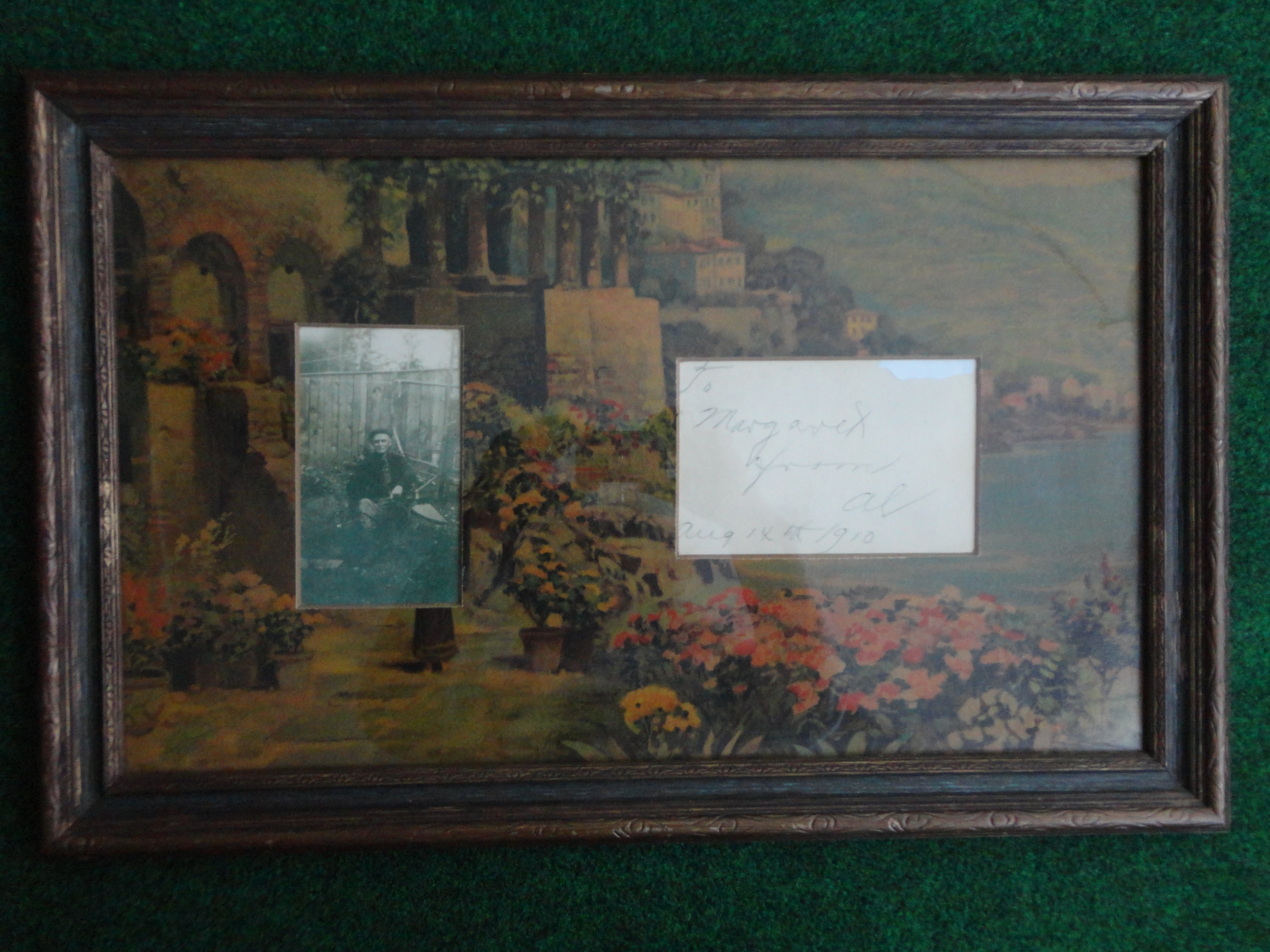
The back of the photo holds a simple inscription: To Margaret from Al Aug 14th 1910

My curiosity was piqued. The first question I ask when writing in response to one of my photos is, ‘What’s your story?’ Why had Al had his picture taken in his backyard? Who was Margaret? He didn’t sign it ‘Love, Al’ so were they just friends? Was she his sister or another relative? Was this an early form of a personal ad and Al was showing Margaret he had a home before he began courting her?
Then I looked at the date and did some research. One of the first things I found was the early gatherings of the Women’s Suffragette Movement. The story took shape. Al’s expression was forlorn and the photo a love letter to his wife who was caught up in this new movement that had completely turned his world upside down.
Here is their story in an ekphrastic poem.
To Margaret from Al
Aug. 14th, 1910
I’m lost
in the garden we worked
side by side, our movements
mirrored in my digging
and your planting.
Our rhythm, familiar
as the seeds and soil.
The beat
of the suffragette drum
calls you from our beds
Dirt-crusted gloves,
replaced by a yellow armband,
hang by the back porch door
where you planted flowers
to soften and brighten the edge
and where I wait
among your daisies,
buttercups and jonquils.
Yellow was the color of the Suffragette movement and while Al believed those sunny flowers were planted to brighten the home, they were actually a sign that the woman living in that house supported the movement. After everything, I like to think Al and Margaret found their way back to their garden.
I’ve also heard that ekphrasis can describe any art form that is inspired by another art form. Years ago, I attended a dance performance by Unbound, a modern dance company out of Columbia, SC. They had requested personal essays written by women survivors. Out of those received, stories of domestic abuse, cancer, miscarriage, and others, the company chose 8 or 12 to choreograph. My friend Ginny’s story was chosen.
Ginny has Friedrich’s Ataxia, a progressive genetic disorder that affects the body’s nerves. During college and later, Ginny was a club singer, her costume a sexy red dress. By the time I met her the disease had forced her to use a walker and her singing days were long past. The dancer who portrayed Ginny began her dance in a vibrant red dress and moved freely across the stage. She gradually took on a cane, then crutches, a walker, and finally a wheelchair. Each apparatus became a partner in her dance; each time she gained a new partner, a piece of the red dress was stripped away to reveal a white piece beneath. Eventually all the red was gone.
The literary art of personal essay transformed into a visual, moving piece of art. A vivid description and one that impacted the viewer.
April is just a few weeks away and is National Poetry Month. I know a group of poets who’ve been working on some ekphrastic poetry, and I can’t wait to tell you about their project. Have a great week!
 A Writer's Window