“What no wife of a writer can understand is that a writer is working when he’s staring out the window.” ~ Burton Rascoe, American journalist, editor, literary critic
I don’t stare out my window so much, but I do stare off my deck. And hubby doesn’t understand.
This morning, 6:15, the birds are waking. One is calling Jeremy-Jeremy-Jeremy-Jeremy, another answers Spritz-Spritz-Spritz-Spritz-Spritz.
From my vantage point I face a corner of the deck.  Nandina bushes with their clusters of grape-like berries, and a mimosa tree with its frond-like leaves border the railing. All are covered in dew and glisten as the sun finally touches the top of the trees.
I watch a fog rise with the sun’s warming. It adds an ethereal quality to my side yard, the farthest branches of the bushes and the woods beyond. Woods shrouded in a thin veil of mist glow white.
The sun lifts further, breaks through the fog, and hits the back yard in splotches of yellow-green. I hear the pattern of bird calls, always four for Jeremy and five for Spritz. The dew beads roll off frond tips and the curves of berries, drop like rain in a syncopated beat. The warmer the air, the faster the beads roll. I watch them fall, their tracks shimmer in the sun, look like strands of silk.
I look to my left and I’m surprised to see what the rays reveal – a large, perfectly spun web connecting a nandina to the deck. The circular strands are scalloped evenly, hanging from the weight of dew.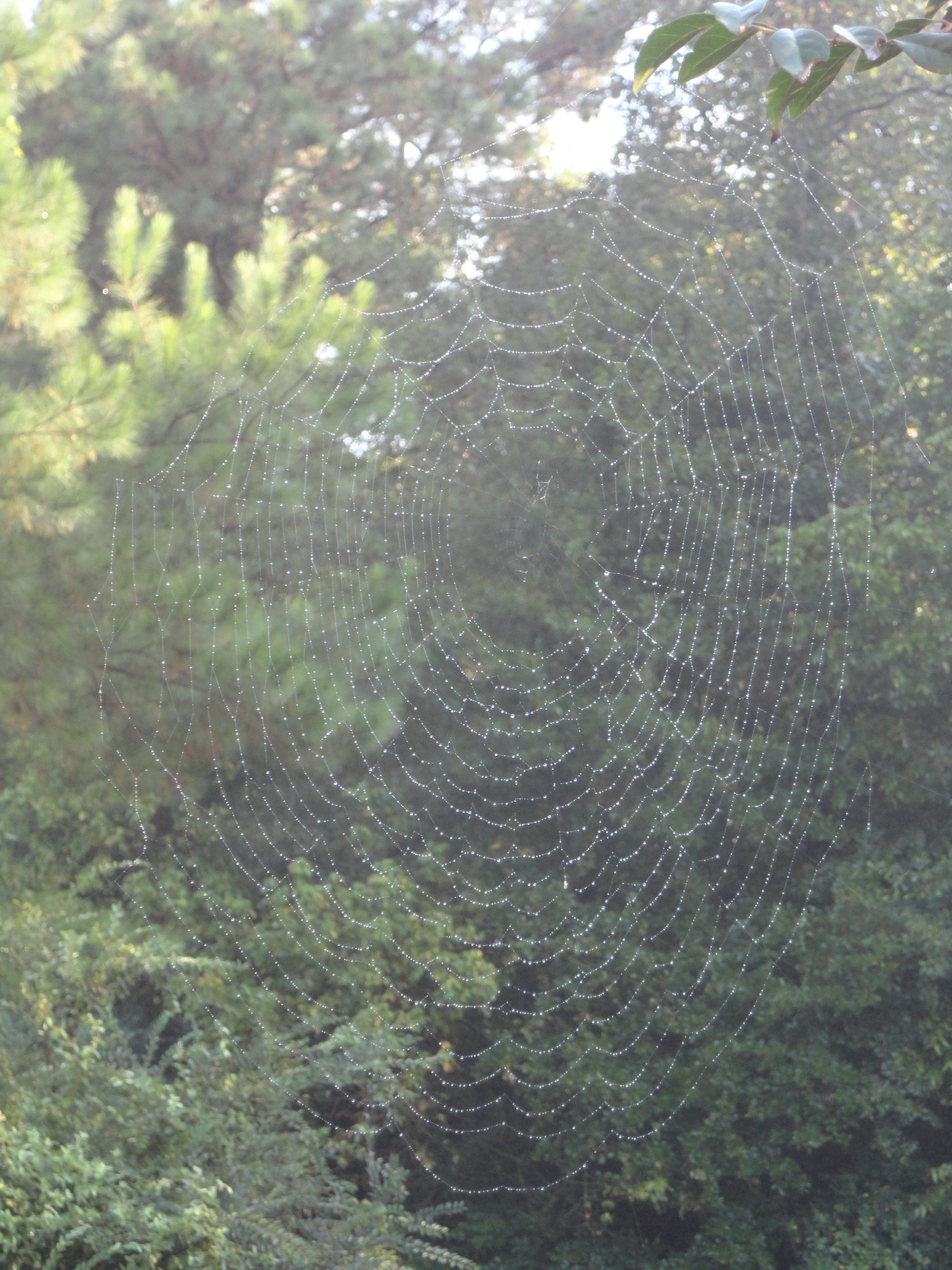 So where does all this staring lead a writer?
If I were a children’s author, Jeremy and Spritz would be making all kinds of plans for the day ahead! But I’m not so I’m focused on the patterns. I think of all the patterns in nature, how everything is created in an order. Once I see patterns, it’s a challenge not to see them and I search for them. That curiosity extends to those in human nature too.
I just now realize yellow-green is the color of sun hitting grass and leaves!
I listen to pseudo raindrops and they remind me of the cartoons I watched growing up – the good ones :-). Raindrops were paired with notes of classical music. It wasn’t until years later I read this was done to introduce children to classical music and the ballet. Is that still being done? Do our children miss out on something if it’s not? I imagine I’m not the only one who first heard 1812 Overture on a cartoon and not played by a symphony.
The web looks like an oval Victorian mirror, so beautiful and I try to come up with a description that isn’t such a cliche. As the dew falls and dissipates, and the nandina branches lighten and rise, what will happen to the web? Will it stretch or will it break? I think of the spider’s diligence and perseverance making the web during the night. (It’s always at night isn’t it? Then we walk into them in the morning when we don’t know they’re there – Yuck!)
The web becomes a metaphor for so many things: fragile beauty; how even our best efforts can be undone by things out of our control; how we sometimes have to stretch when outside forces pull, sometimes we break; perseverance, diligence and hope.
Then writers spin the observations into words and weave them into poetry and prose – the rest of our work.
 A Writer's Window