
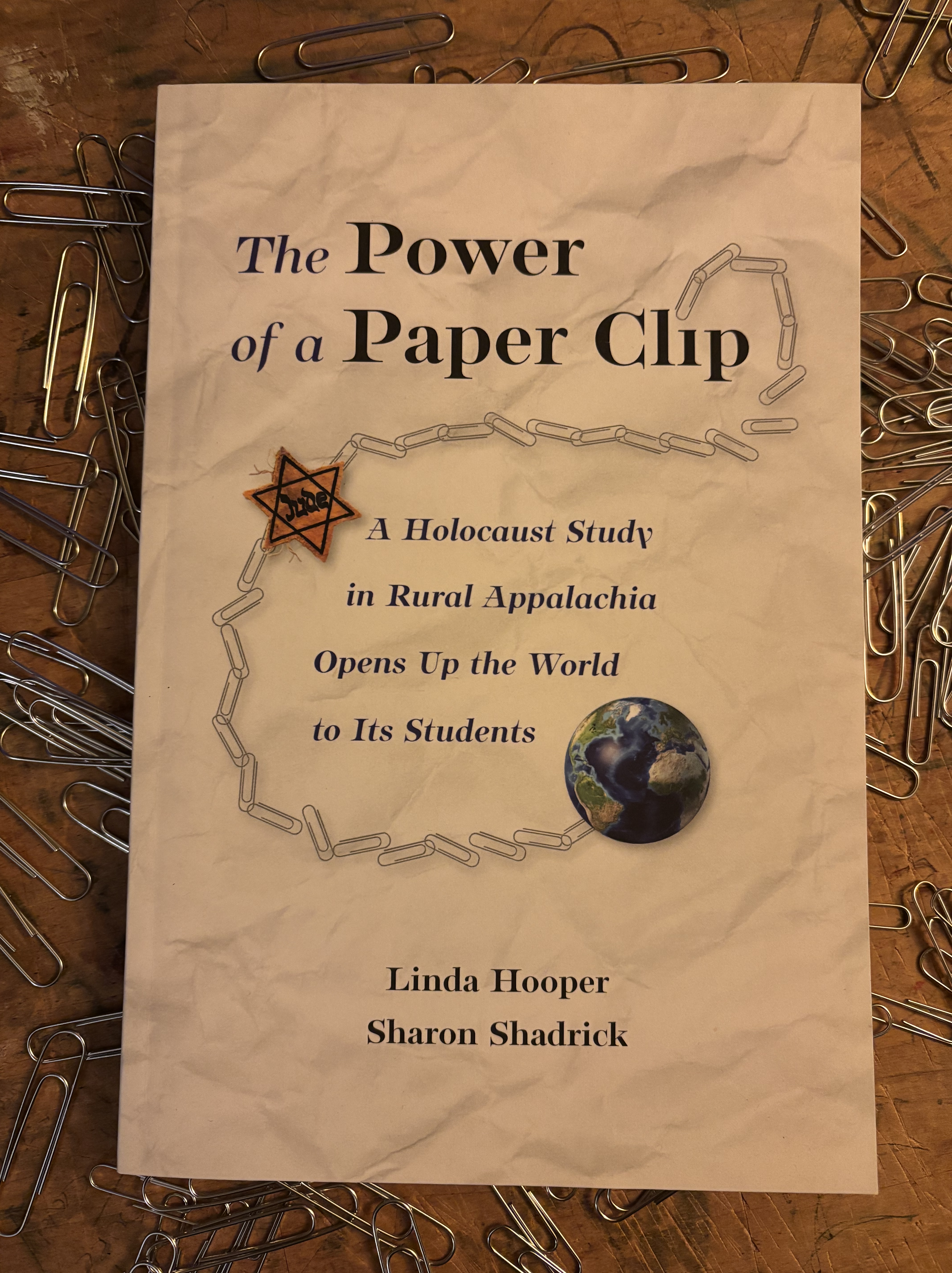
I’ve written before that through my writer conferences I’m lucky to meet other writers, and discover books that aren’t published by one of the big publishing houses. These are often books that don’t receive the publicity or readership they deserve. The Power of a Paper Clip is another one of those books. Though classified as biography and autobiography on one of the book sites, I found it part memoir, part travelogue, part history, part suspense … and full part inspirational.
In 1998, in small rural Whitwell, TN (population 1,600), middle school principal Linda Hooper wanted a way to introduce diversity and tolerance to her homogenous students. She asked her Vice Principal David Smith to attend an iEarn (International Education and Resource Network) conference to learn about projects that would connect the students via the internet to students around the world. (from The Power of a Paper Clip.) Smith returned from the conference with the idea of teaching the students about the Holocaust.
The study group classes went well enough until one of the students asked, ‘What does six-million look like?’ the number of Jews murdered. That’s a number many of us can’t fathom. The project changed dramatically when the students asked permission to come up with a way to visualize that number. Hooper agreed. And they did. They would collect six-million paperclips!
There are several reasons why they chose this common object, but the most important is that during WWII, Norwegians adopted the paper clip as a secret symbol of solidarity with the Jews. They wore paper clips on their clothing like the Jews wore their stars.
The Power of a Paper Clip chronicles the journey from Hooper and Smith, and teacher Sandra Roberts’ early lessons on the Holocaust to the impact of the students’ Paper Clip Project on the community of Whitwell … and beyond. The book is a short 128 pages, but authors Hooper and Shadrick capture the moments the students’ eyes were opened and their compassion deepened. And how the lessons came full circle when these middle schoolers in a rural Tennessee town met Holocaust survivors. The journey is filled with surprises (I’m not going to give all of them away!) and like I said, inspiration. I’ll never look at a paper clip in the same way.
Today, January 27, is International Holocaust Remembrance Day, “…the day chosen to commemorate the date Auschwitz was liberated by the Red Army.” (Wikipedia)
I remember reading The Diary of Anne Frank in either middle school or high school. While I don’t remember exactly when I read it, I remember its impact. Writer Richard Price once said, “The bigger the issue, the smaller you write. You don’t write about the horrors of war. No, you write about a kid’s burnt socks lying on the road.” The Franks being in hiding for over two years in a cramped apartment was a burnt socks moment for me. The few photos of emaciated bodies in my history books were hard to look at and the reality of those images hard to imagine; but I could feel the claustrophobic walls of that small apartment. Reading about the courage of Jan and Meip Gies, the couple who hid the Franks and two other families, made me fearful for them. Obviously for good reason as they were eventually reported to authorities.
Today, The Diary of Anne Frank, along with other books about the Holocaust, are being targeted for censorship and banning. There are those who deny the horrors of the Holocaust ever actually happened. As of January 2024, only 245,000 Holocaust survivors are still alive worldwide. We are losing our living history.
To put that number in perspective, as of 2023 the population of NYC was 8.258 million; of Charlotte, NC (911,311); Detroit, MI (633,218); and Port St. Lucy, FL (approx. 245,000). The number of living Holocaust survivors would barely fill a small Florida town. We are losing our living history.
If certain groups get their way, not only will we lose our history, it will be rewritten. In the last week I’ve wondered who of us will have the Gies’ courage to take a risk when it’s asked of us. I have no doubt the community of Whitwell, TN will.
In addition to The Power of a Paper Clip, a documentary was produced, Paper Clips, and is available for viewing through Amazon Prime and Netflix. Hubby and I watched it last week and tears were shed during powerful Wow! moments. In one scene one of the survivors tells the students how grateful he is for their dedication in keeping the Holocaust story alive and how he wishes there were more young people just like them.
The Power of a Paper Clip is available through
I hope all of you have a wonderful week. I’ll be back at my window on Monday! I leave you with these words from Principal Linda Hooper.
Paper Clips, ‘… the documentary is a reminder…This is a story that demonstrates how even the smallest symbol, the poorest community, and people with no visible power can create a memorial to make a powerful statement for the world. It is a message that must never be forgotten. This book is written to remind everyone that all it takes is ONE person, idea, community with a vision to change the world and give hope for a better tomorrow.’
 A Writer's Window
Thank you so much for featuring our book in this post. It was a five-year labor of love.
Hi Sharon, you’re very welcome. I really enjoyed the book and the documentary. What an amazing project by the school. Your love and admiration for it and those students came through in your book. I hope to see you in Table Rock in August.
~Kim