Happy Monday! I hope you had a wonderful week. We had rain and I got to play in the dirt so you know my week was good.
Keeping my intro short this week because I want to introduce you to my friend and author, Laurel Ferejohn. We at Table Rock Writers Workshop many years ago and it’s always exciting seeing fellow Rockers’ hard work in print. In last week’s post I reviewed her novel, Crossings, and today I’m talking with The Writer Behind the Words. Whether you’re a writer yourself or a reader, getting inside dirt on the making of a novel is, at least for me, interesting. I think you’ll find Laurel’s story about the story interesting, too.
Laurel is a writer of fiction, memoir, and poetry, and her work appears in Quiddity, Thomas Wolfe Review, Southeast Review, Flash Fiction, Salvation South, and others. Crossings is her debut novel and a labor of love. Along the way, it was named to the longlist for the Lee Smith Novel Prize, and a story in one of its chapters won the Thomas Wolfe Fiction Prize.
Since she emerged from a career in journals publishing, Laurel has been an independent developmental editor for writers of creative prose for nearly 15 years, and she teaches an occasional online flash writing class.
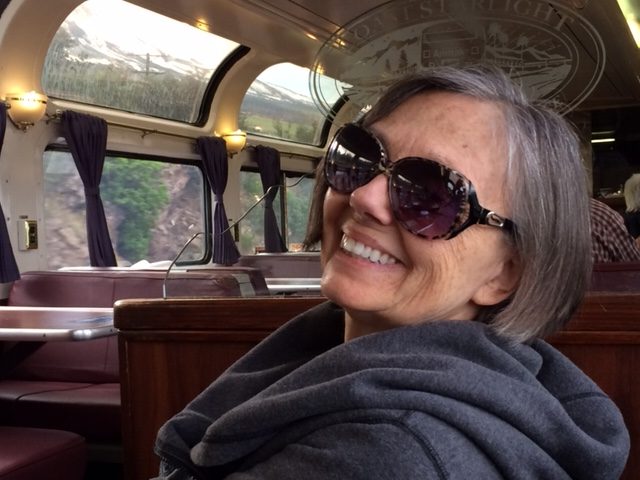
California born and raised, Laurel has lived in North Carolina for four decades, the past twenty-four years with her wife in Durham. She attends Table Rock—her all-time favorite writing workshop—annually in the beautiful Blue Ridge Mountains. Her favorite pastime is—what else?—reading, and her idea of a great travel experience is a cross-country train trip, which often turns into a writing retreat on wheels.
KBH: Okay Laurel, let’s talk inspiration. As a reader and a writer, I’m always curious where the story comes from. What was the ‘seed’ for Crossings?
LF: Some important aspects of the story come from my own life as the very young wife of a young Marine stationed at the air base on Oahu. At some level it seemed like an important story even as I lived it, but it was about fifty years later that Tomby entered the picture, and I realized I would have given a lot to have a friend like him. But I’m not sure I could have, as I was much shier than Valetta. I think I wrote her the way I did because I would have liked to hold my own the way she (in her own way) does.
KBH: Crossings takes place in 1968 against the backdrop of the Vietnam War, and during one of the most historically eventful years in American history–including the assassinations of Martin Luther King Jr. and Robert F. Kennedy Sr., signing of the Civil Rights Act, and the burgeoning women’s rights movement. How did you choose this specific year during the Vietnam War to focus on, and how did that choice influence the development of your characters?
LF: At first, I set it in 1969, because that was my first full year there, when everything began feeling pretty alienating and cut off from anyone I knew. But then in my research I found that 1969 marked the beginning of the “Vietnamization” period, which ushered in the start of Marine Corps troop drawdowns. I wasn’t aware of that at the time, even though it would have meant my husband and those he worked with would be very unlikely to get orders (they never did). That major shift was not, I guess, something the Marine Corps shared with its enlistees. Or maybe it was something those enlistees didn’t share with their wives.
So, my setting became 1968 instead, and it gained traction in my writing as I considered the cultural, political, and social watershed that it was. The upheavals of that year made it feel like the right year for this story. For the women characters (all straight, with the possible exception of Valetta, who nonetheless is vulnerable inside her marriage), the advent of birth control was a sea change, and I wrote it into their lives. Dreaded pregnancy, hoped-for pregnancy, miscarriage; abortion illegal in most states and hardly spoken of—there is so much there of deep importance to women, who were largely unable to plan our own lives.
And among the rest of the societal earthquakes, by 1968 the anti-war protests could not be brushed off as student foolishness, not after the late-fall 1967 massive march on the Pentagon. And yet, in my experience, enlisted Marines seemed to willfully refrain from talking about it, as though to do so might constitute a betrayal. That’s why such protests come up in Crossings only twice: once at the birthday party when one of the guys refers to the riots at the 1968 Democratic National Convention in Chicago as an “asshole hippie yippie thing,” then quickly segues into making fun of Dixon. The second time is at the Thanksgiving gathering, after the unit has gotten orders to Vietnam and so the pressure is dialed way up. The brief talk of protests again is steeped in disdain, except for one of the wives, who in muted tone refers to protesters as just standing up for what they believe in. Some at the table give her a hard time, including Kiki, who calls her “our own little lemming.”
KBH: Let’s talk story and characters. Throughout the novel the desire and risks of Crossings are revealed in different ways: expectations vs inner truths, duty vs freedom, fear and finding sanctuary. Keeping that in mind … and without giving any spoilers
KBH: One of the two main characters, Valetta, is a recent high school graduate, thrust into a whole new life–marriage to a serviceman and moving thousands of miles from home. What elements of her character did you find the most challenging and the most interesting to explore and write about?
LF: I think most interesting to write was Valetta’s self-denying sense of responsibility; of who is her responsibility: all of them male (Dixon, Bailey, Tomby (though she tries to do that relationship differently), sometimes even her psychiatrist). It was a revelation to me as I wrote her grappling with—talking out loud about—this very question of responsibility in appointments with Dr. Schiffer. She also feels in a way responsible for Grandma Fia’s health, especially around smoking, but there it feels healthier—real care based in love, rather than a self-denying guilt over not having done enough (Bailey) or over what will happen if she withdraws her responsibility (Dixon).
The aspects of Valetta that challenged me as I wrote are those most different from me at that point in my life: her courage in planning how she can leave, sharing those plans in a secret friendship, finally standing up for herself and telling someone off. Valetta is different from me in most ways, but I feel very close to her, and her near-constant inner musings feel familiar to me, especially at that time when I was most alone. In terms of personality, though, perhaps Dory has more in common with the me of that time.
KBH: In Crossing’s first two paragraphs you open with a tension-filled scene of Tomby being bullied out in the ocean. As I continued reading the book, that scene proved symbolic for the struggles he and Valetta faced independently and together. What insights can you give about each of them that make their unlikely friendship work so well?
LF: They are able to meet in the first place because they both have enough curiosity, enough confidence in their secret-keeping abilities—and enough need—to enter into conversation with someone who seems to give off a good vibe (his first impression of her: “Someone with some sense”; and hers of him: “He didn’t move like a Marine. … He didn’t dress like a Marine, either.”) They are both willing to take a chance on their instinct. In their very first conversation they are able, using a bantering kind of code, to signal to each other that they’re on the same wavelength. For example, Tomby, broaching the idea of lunch, says, “… unless your husband would object” (or commit mayhem—he says that part in his head); and Valetta says she is “not inclined to make any announcements.” Then over time, although they are each still not telling the hardest stuff, their willingness to take each other at face value without demanding more—even when they suspect there is more—allows that initial trust to grow and their friendship to deepen. So that when the time does come for serious requests (never demands), they are able to come together.
KBH: In addition to Valetta and Tomby, there are other wonderful, complex relationships. Two in particular are Tomby and Lili, and Valetta and Miss Mori. Getting inside Tomby’s and Valetta’s heads, what do you think they found the most interesting, surprising, or comforting in those relationships?
LF: Valetta’s openness to an older mentor is experienced in her special affinity and respect for Grandma Fia. Unlike Valetta’s mother, both her grandmother and Miss Mori listen to Valetta and offer wisdom that feels in tune with her hopes and aspirations. And most surprising, Miss Mori goes deeper—shedding light on what may be an inner realm that Valetta hasn’t explicitly divulged even to herself. Miss Mori also commits a completely unanticipated act of generosity that will always symbolically connect the two women.
Tomby’s affection for Lili, proprietor of an off-limits Honolulu bar, is rooted in their mutual queerness. Tomby has never met someone brave enough to be openly transgender. He doesn’t even have access to that concept and language, and neither does Lili, because it hasn’t taken root among the public yet. But in this brief acquaintance, Lili—older and much more experienced—helps Tomby to own his own truth, even though he has to be closeted if he wants to be safe (and she makes it clear she wants him to be safe—as does the reader, I hope). They create the kind of bond that will last their lifetimes.
KBH: Life on a military base has built-in tension and built-in family. The Vietnam War ended 50 years ago. Given the tension and family present during Crossings, which other wife–if any–would Valetta still be in touch with?
LF: All of the wives in her husband’s small circle of buddies end up demonstrating their friendship for Valetta, and she is amazed, even though she’s the one who kept them at arm’s length almost throughout the story, unable/afraid to open up to any of them, even the two who are nice to her, both because of her natural reluctance and because of their closeness to Kiki, and through her, to Valetta’s husband. The irony is that in the end, Kiki becomes the one most likely to be welcomed into long-term friendship with Valetta.
KBH: Let’s talk craft. So much goes into writing a novel that makes the work fun and frustrating. The timeframe for Crossings is just a few months. What were the challenges and the advantages of working within a tight time frame?
LF: To make sure the time frame was tight, the first thing I did to help guide revision was to make a timeline spanning all scenes, noting whose POV each was and adding a few words to describe what happens in each. (Also, color coding gave me a visual representation of the distribution of Tomby scenes compared to Valetta scenes, and of the distribution of themes.)
I wanted the story to feel tight all over, pressurized, the way life felt for both Tomby and Valetta: a compressed time period, a looming war, a small island, tiny living quarters for both of them, hemmed-in norms of behavior, self-imposed high walls (secrets to guard, feelings to hide), the close scrutiny by those around each of them, the phone booths, the barracks packed with “racks” (cot-like beds) and footlockers, and, for Valetta, the psychiatrist’s literal couch, and the narrow area that she holds to as her side of the marriage bed—all of this together like a crucible.
And all of that contrasts with the physical expansiveness of ocean and sky, which also, ironically, represent physical constraint, holding them on the island: flying off is not an option, given that Tomby is legally bound to the Marine Corps and Valetta hasn’t got the money it would take. And Tomby’s convertible can’t drive them beyond the all-too-close land’s end in every direction. I experienced that crucible in all of those ways during my time there, and the contrasting but still prohibitive endlessness of ocean and sky stretching in every direction. Tomby’s and Valetta’s attempts at navigation are aimed at getting out, getting free, getting their breath, expanding their space and their inner lives, feelings, selves.
KBH: Writers often go into a project with an idea of where the story will go and who their characters are, then get surprised along the way. Did any of the characters say or do anything that surprised you? That changed the trajectory of the story or affected your vision for it?
LF: There were several surprises! And I’m so grateful for them! Miss Ito, the bedridden partner of Miss Mori; the maps; Lili and her bar Hokeo, and its back room; the secret that is revealed by Freddy at the Thanksgiving gathering; Dixon’s wedding ring; the scene near the end with Valetta and Kiki, the wife who from the start makes no secret (among the women) of her attraction to Valetta’s husband. These didn’t change the trajectory or my vision, but filled out the story and supported my vision for it in really important ways. The novel wouldn’t be as rich—or I should say, would not be rich enough—without them.
KBH: Is there anything else you’d like to share about yourself, your writing, or Crossings?
LF: Though all of the characters are fictional, many elements of the story are based in my own experience, including the basic ones: a nineteen-year-old woman questioning her sexuality while living unhappily as the wife of an also unhappy Marine stationed on Oahu. Even at that time, the pressurized nature of the island; my inability to travel home or even make a long-distance call more than once or twice a year because of lack of money; the prescribed duration of my husband’s term of duty, which by extension became my prescribed duration with him—and a few specific experiences that are now depicted in the novel—all struck me, for all those years after leaving the marriage and the island, as a story waiting to be told. Sadly, though, for so long I didn’t see myself as a writer. I didn’t start writing seriously until nearly my sixties, thanks to a mentor in my own life. Now in my mid-seventies, I’m telling it in fiction—and I have written into it the friend I wish I’d had back then.
Thank you, Laurel! I look forward to hearing you on your reading circuit once Crossings goes live.
And there you have it! Don’t these tidbits and insights make you even more curious to read Crossings? A reminder where you can pre-order the book.
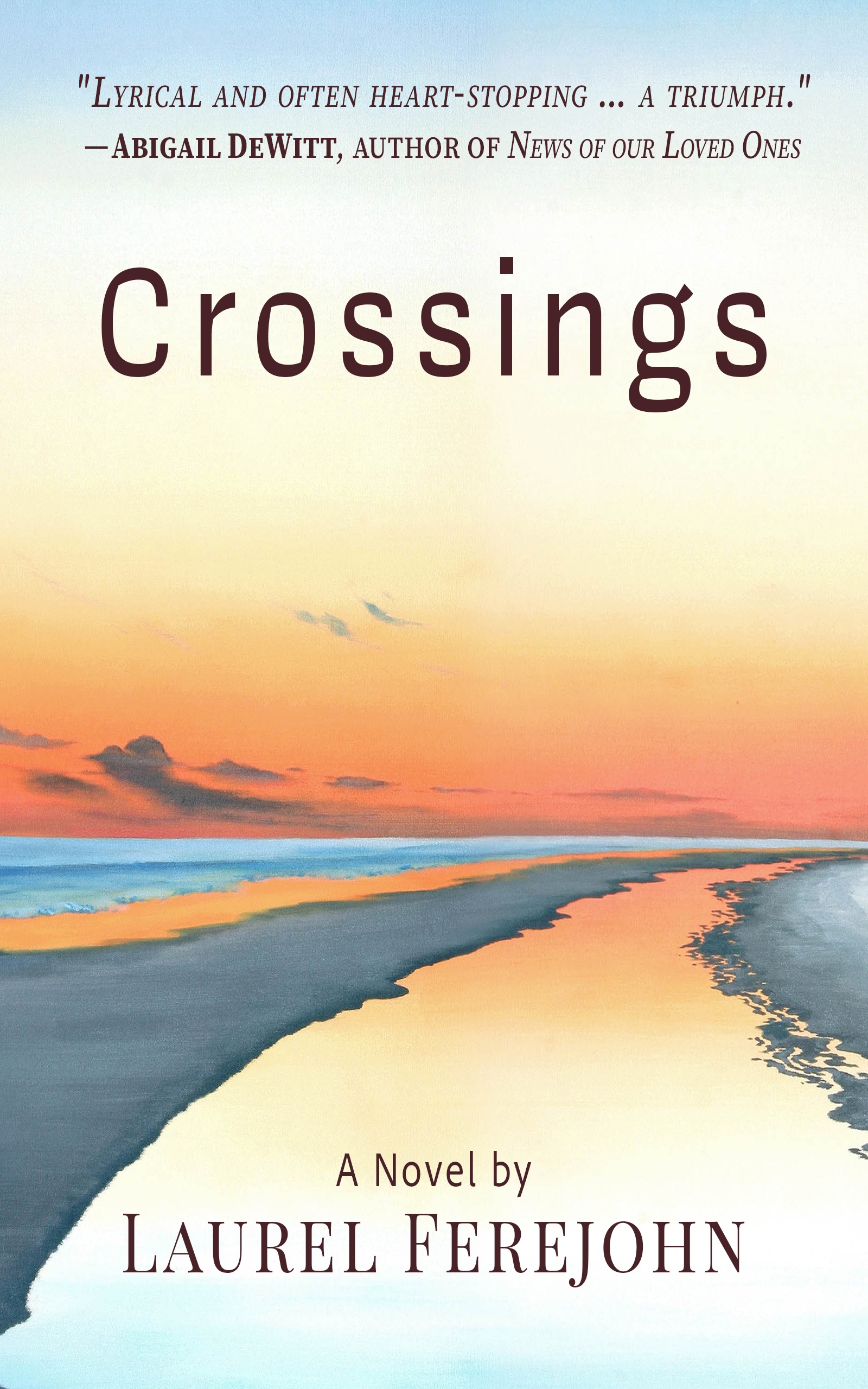
Barnes/Noble (not letting me link but you can find it here!)
May you all have a wonderful week. I’ll be back at my window on Monday and I hope you will join me.